
Senate Roundtable with Franck Petitta: "The Turmoil of the French Animation Industry"
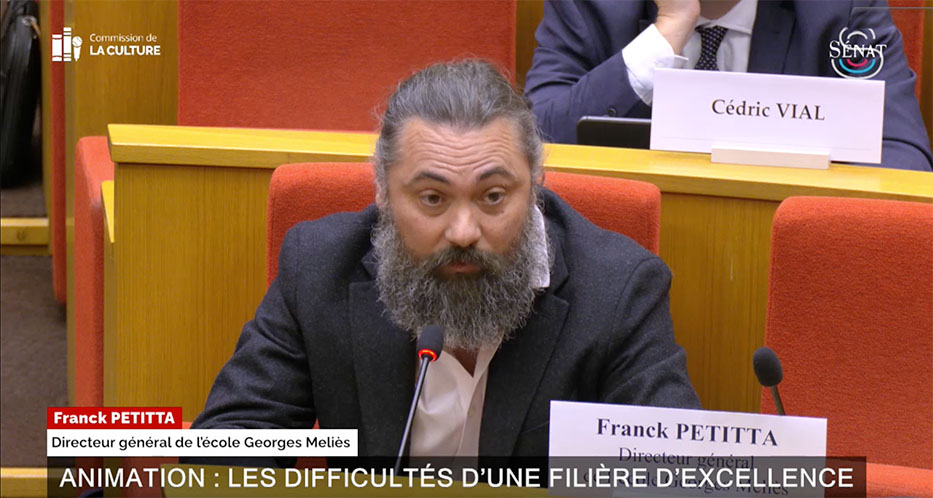
Third largest producer in the world, second largest exporter: while French animation shines through its excellence, it is traversing a major structural crisis. On January 7th, industry heavyweights, including Franck Petitta, founder and director of École Méliès, alerted the Senate to the urgent need for action.
The list of guests present at the Palais du Luxembourg testifies to the gravity of the situation. Alongside Samuel Kaminka (President of the AnimFrance Union), were emblematic figures such as Marc du Pontavice (CEO of Xilam - Oggy et les cafards), Hervé Dupont (Deputy CEO of Fortiche Production - Arcane), and Valérie Moati (General Director of Gobelins Paris - Paris Chamber of Commerce).
The verdict is undeniable: despite critical success, the sector is suffering a 16% drop in hours worked. A brutal fall caused by the withdrawal of investments from American platforms and the migration of audiences to YouTube, which captures value without funding creation.
Vital Demands for Survival
Facing the Committee on Culture chaired by Laurent Lafon, industry players insisted that the French model, based on public-private co-construction, is in danger. The dependence on France Télévisions, "which accounts for 50% of industry orders," makes every budgetary decision critical.
Producers are notably demanding an urgent reform of the tax credit, whose cap dating from 2005 has become obsolete in the face of production costs for the premium works that drive our international reputation.
Training and AI: Franck Petitta's Warning
At the heart of these economic stakes, Franck Petitta carried the voice of the next generation. While artificial intelligence raises concerns due to its capacity to massively scrape protected works without authorization, he insisted on the risk of seeing AI replace craftsmanship, directly threatening the professional insertion of young graduates.
Echoing his counterparts' observations, he pleaded for training that prioritizes creators over simple operators. For Franck Petitta, the challenge is to preserve an "artisanal intelligence" in the face of automation, ensuring that students remain creators who master their tools, and not the other way around.
This roundtable shed light on the fragility of a sector that is nevertheless strategic for French "soft power." It remains to be seen if this call for help will be followed by concrete legislative effects.