
École Méliès

Since · Orly, Île-de-France

Festival
Méliès

The path of all storytelling

Watch replays of the talks and interviews from every edition: directors, VFX supervisors, art directors and producers share their vision of the industry and a behind-the-scenes look at their craft.

Illustration for the Festival Méliès, organised by the Méliès School in Orly — the annual gathering of film and image professionals
Festival Méliès — Méliès School, Orly

4th Edition ·

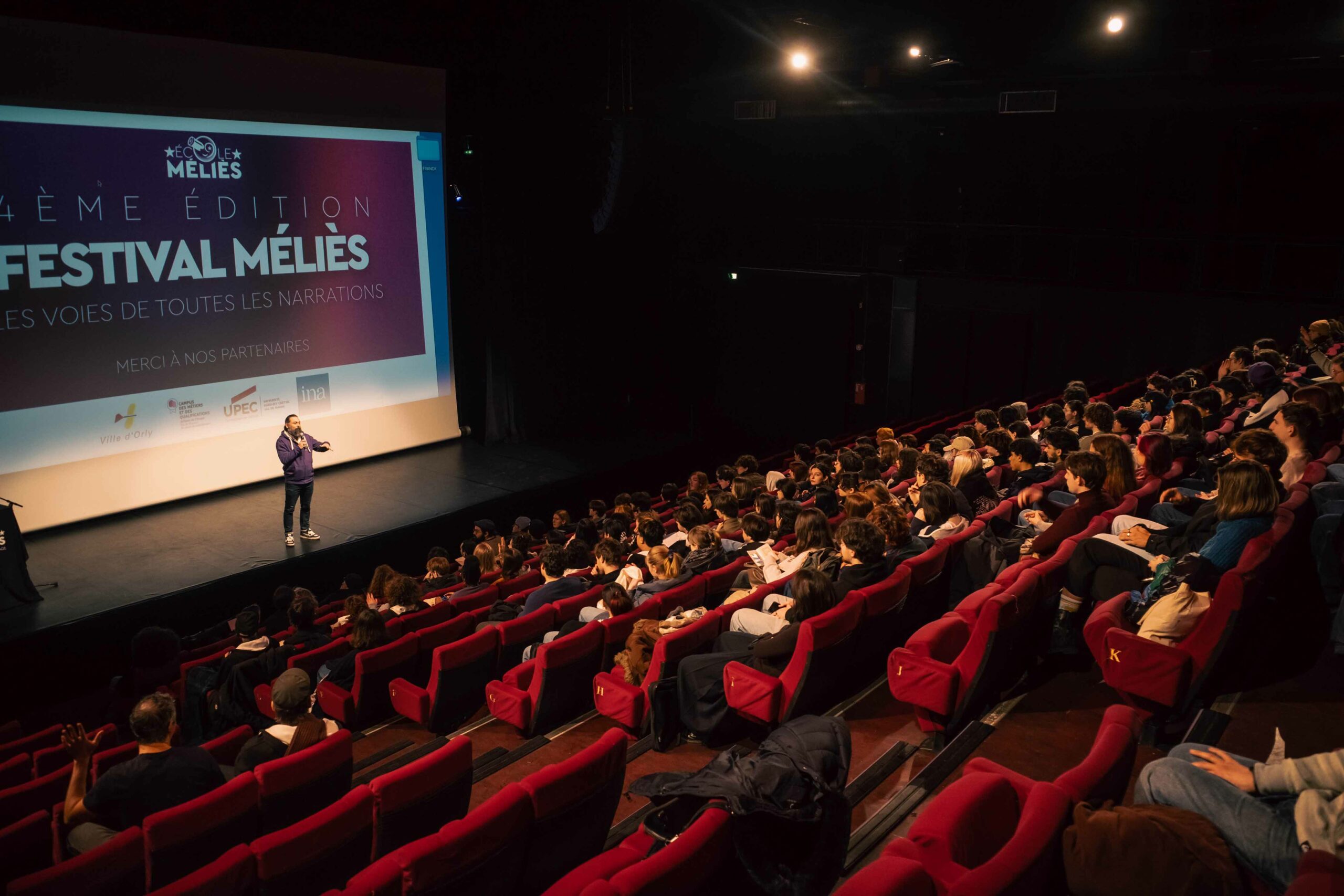
The 4th edition of the Festival Méliès, held in , brought together twenty contributors for talks and interviews on the crafts of film, audiovisual and visual effects.

Programme (PDF file)

Talks

9

Body Language: a 3D animator's journey from France to New Zealand

How does body language become the foundation of character animation? Vincent Caudeville, a senior 3D animator with over 20 years' experience (Wētā FX, Framestore, Illumination Mac Guff), looks back on his path as a 3D animator — from his training and early days in France to settling in New Zealand, at the heart of the international visual-effects industry. He explores body language as the foundation of character animation, whether in animated films or in live-action films enriched with VFX. Drawing on concrete examples from major productions he was lucky enough to work on, the talk highlights the importance of observation, emotion and the interpretation of movement, beyond mere technical reproduction. Body Language offers a sensitive, human look at the animator's craft, where feeling remains at the heart of performance.
The Singular Film, a Self-Portrait of Cinema

A singular film — a first feature with no sequel — owes its uniqueness as much to the unusual circumstances of its creation as to its ability to express everything cinema can offer that is vital and cathartic. By connecting this gem to its kindred works of solitude, an unadorned portrait of the seventh art takes shape…

Why imperfection matters in animation

In this masterclass, you will learn how the brain interacts with expressions and emotions, body language and non-verbal communication, and the "imperfections" that give a character psychological authenticity — all to sharpen the precision of your animation, break free from generic styles and captivate your audience.

VFX Design: narrative innovation & visual revisionism

Before being an illusion, visual effects are above all a narrative element, meant to make the viewer believe in the world the director wants to draw them into. But in an age of endless sequels and remakes, how do you keep consistency over time? Does a design created in one era still mean the same thing in another? At a time when technology allows every extravagance, where does evolution end and visual revisionism begin?

A good screenplay for a good film

A conversation between Julie Ponsonnet, screenwriter, and Zulma Rouge, author-director, about their experience of writing and co-writing. They discuss their working methods and the stakes of the dialogue between authors. The focus is on the importance of dramaturgy in developing stories and on the narrative choices that structure a work.

Too many special effects, not enough story?

"Machinery play", "trick film", "special-effects film": from the theatre of attractions of the 19th century onward, the debate has raged between those who condemn the place of tricks on stage — accused of weakening a play's story — and those who believe, on the contrary, that spectacle is essential to theatrical art. From the 19th to the 21st century, and of course by way of Méliès, this talk explores the complex relationship between special effects and the art of storytelling in general.

Storyboard: 90 films and series in a single stroke

Drawing on concrete examples from more than 90 films and series, Éric Gandois reveals the essential role of the storyboard in making a film. He discusses his working process, his collaboration with directors, translating the screenplay into images, and the stakes of staging, rhythm and visual storytelling. The talk takes the form of an open conversation, punctuated with anecdotes and clips, followed by a Q&A with the audience.

Stan Manoukian

Description not available

Audrey Ferrara: from the Méliès School to global blockbusters – VFX Supervisor

Audrey Ferrara oversaw the visual excellence of Mufasa: The Lion King, after working on major hits such as The Lion King, The Jungle Book and Alien: Covenant. Her mastery of photorealism has made her a key figure in today's international blockbusters.

Interviews

10

Denis Brusseaux

A journalist specialising in film and video games (DVDRAMA, Joypad), a screenwriter (LE GUETTEUR, 2012, by Michele Placido with Daniel Auteuil and Mathieu Kassovitz; SIX JOURS, 2025, by Juan Carlos Medina with Sami Bouajila and Julie Gayet) and an author (Nicolas Cage, la folie au tournant, Éditions du Layeur, 2022), and Narrative Director at Ubisoft, Denis Brusseaux has for several years been involved with the École Georges Méliès, which gives him the chance to express his other passion: passing on experience and knowledge around one of the key challenges of this century — storytelling.

Benjamin Weislo

With 15 years' experience as a senior animator (Illumination, Mikros, Skydance…), he also specialises in acting, body language, neuroscience, psychology, non-verbal communication, video editing and musical composition. Today he devotes himself to teaching this new approach to animation with the Méliès School.

Bastien Chauvet

Drawn since childhood to storytelling and illusion, he started out in theatre before turning to visual effects. A 2005 graduate of the Méliès School, he moves between animation and live action, working with directors such as Raoul Peck, Luc Besson, Jacques Perrin and Peter Jackson (at Wētā FX). In animation, he works to close the gap between concept art and the final image, notably on Cédric Babouche's projects ("Moustique, Cigale et Cambriole"). After supervising several productions at MPC Paris (Murder Mystery 2, Serpent Queen, Cold Storage), he now devotes himself to teaching the history of special effects, to the secretariat of Level Up and VES France, and to writing his feature film, "Revoir".

Julie Ponsonnet

Julie Ponsonnet is a screenwriter, consultant and teacher. Drawn to cinema early on, she has co-written several shorts and features, including Le Million (by Grégoire Vigneron, with Christian Clavier and Rayan Bensetti), released this past 24 September. She has taught dramaturgy for many years and supports authors and producers in developing and rewriting their projects. She is also the author of a reference book on screenwriting, published by Eyrolles in late 2023: "L'art d'écrire un scénario".

Réjane Vallée

Réjane Hamus-Vallée is a full professor at the University of Évry Paris-Saclay, Centre Pierre Naville, where she heads the master's programme "Image and Society: Documentary and Social Sciences". Her research focuses mainly on special effects (Les effets spéciaux au cinéma. 120 ans de créations en France et dans le monde, with Caroline Renouard, Armand Colin, 2018; Peindre pour le cinéma. Une histoire du Matte Painting, Presses universitaires du Septentrion, 2016), on film crafts (Superviseur d'effets visuels pour le cinéma, with Caroline Renouard, Eyrolles, 2016) and on visual and film sociology (ed., "Sociologie de l'image, sociologie par l'image", CinémAction, 2013).

Maxime Mathis

Maxime Mathis is a film editor based in Paris. A graduate of the ESEC with a specialisation in editing, he has since 2015 worked on many features alongside editor Laure Gardette as an additional editor. He has notably worked on La Prière by Cédric Kahn, La Vie scolaire by Grand Corps Malade, DNA (2020) by Maïwenn and November (2022) by Cédric Jimenez. In parallel he has edited several projects as lead editor, including the feature documentary Soul Kids (2020) by Hugo Sobelman, winner of the 2020 SACEM award for best music documentary; the fiction feature Ma Nuit (2021) by Antoinette Boulat, presented at TIFF and the Venice Film Festival in 2021; Who Do I Belong To? by Meryam Joobeur, selected at the 2024 Berlinale; and The Voice of Hind Rajab, Silver Lion in Venice in 2025.

Eric Gandois

Trained in applied arts (ENSAAMA Olivier de Serres) and animation film (Gobelins), Éric Gandois began with internships (Ellipse Animation, Disney Montreuil), advertising and short films. He entered feature films by storyboarding Philippe Haïm's Les Dalton, then worked regularly with EuropaCorp and Luc Besson on major films such as Jack and the Cuckoo-Clock Heart, Lucy and Valerian and the City of a Thousand Planets, for which he did the entire storyboard. In 2014 he directed Eve, a stereoscopic 3D science-fiction short selected at many international festivals. Today he is one of France's most prolific storyboard artists, with more than 90 films and series across every genre, including Lupin, Versailles, OSS 117, The Count of Monte-Cristo, Balle perdue 2 and 3, Emilia Pérez and Dracula.

Hakim Belabbes

Biography not available

Audrey Ferrara

Audrey Ferrara oversaw the visual excellence of Mufasa: The Lion King, after working on major hits such as The Lion King, The Jungle Book and Alien: Covenant. Her mastery of photorealism has made her a key figure in today's international blockbusters.

Stan Manoukian

Description not available

Scroll to Top